cytoflow.operations.hierarchy#
Convert a hierarchical gating strategy into a categorical condition.
HierarchyOp – Given an ordered list of gate names and their values, create a
categorical variable with values set by gate membership.
- class cytoflow.operations.hierarchy.HierarchyOp[source]#
Bases:
HasStrictTraitsConvert a hierarchical (binary) gating strategy into a categorical condition.
Hierarchical gating strategies are quite common when doing manual gating. For example, an 8-stain panel can separate monocytes into macrophages, B cells, NK cells, NKT cells, T cells, DCs, and neutrophils – but then, because these states are mutually exclusive, a reasonable question is “how much of each are there?”
Cytoflowcan define these gates, but because it does not have any concept of nested gates, plotting and analyzing this gating strategy can be challenging, particularly in the GUI.HierarchyOpconverts a list of gates into a categorical variable to enable straightforward analysis. For example, monocytes stained with CD64, CD3 and CD19 can differentiate between macrophages and B cells. A user defines aThresholdOpgate to separate CD64+ cells (macrophages) from the rest of the events, then they use aPolygonOpto distinguish the CD19+/CD3- cells (B cells) from everything else.HierarchyOpcan take these two gates and create a categorical condition with the valuesMacrophages,B_Cells, andUnknown.The operation is set up by providing a list of conditions, values for those conditions, and the category that condition indicates. Figuring out an event’s category is done by evaluating the hierarchical gates in order. For each event, the first condition/value pair is considered. If that event has that value, its new category is set accordingly. If not, then the next gate in the list is considered. If the event is a member in none of the gates, it receives the category listed in the
defaultattribute.- name#
The operation name. Used to name the new condition in the experiment that’s created by
apply.- Type:
Str
- gates#
The ordered list of gates that implement the gating hierarchy. Each three-tuple has the following format:
Str- the name of the gating operation. (Must be a key inExperiment.conditionsand a column inExperiment.data)Any- the value that the gate has to have to indicate membership in this class.Str- the name of this class’s category, to put in the new condition.
- Type:
List(Tuple(Str, Any, Str))
- default#
The name that unclassified events will have in the new categorical condition.
- Type:
Str (default = “Unknown”)
Examples
Make a little data set.
>>> import cytoflow as flow
>>> import_op = flow.ImportOp()
>>> import_op.tubes = [flow.Tube(file = "Plate01/RFP_Well_A3.fcs",
...                              conditions = {'Dox' : 10.0}),
...                    flow.Tube(file = "Plate01/RFP_Well_A6.fcs",
...                              conditions = {'Dox' : 1.0})]
>>> import_op.conditions = {'Dox' : 'float'}
>>> ex = import_op.apply()
Create two threshold gates, simulating a hierarchical gating scheme.
>>> ex2 = flow.ThresholdOp(name = 'B1_high',
...                        channel = 'B1-A',
...                        threshold = 500).apply(ex)
>>> ex3 = flow.ThresholdOp(name = 'Y2_high',
...                        channel = 'Y2-A',
...                        threshold = 300).apply(ex2)
Define the hierarchical gating scheme.
>>> ex4 = flow.HierarchyOp(name = "Cell_Type",
...                        gates = [("B1_high", True, "B1_high_cells"),
...                                 ("Y2_high", True, "Y2_high_cells")]).apply(ex3)
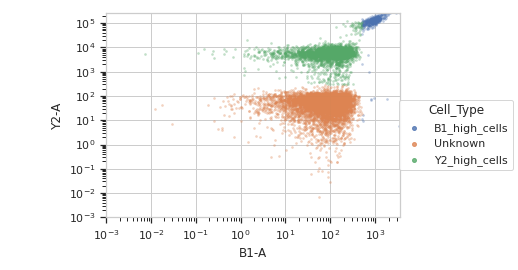
Plot the new categories.
>>> flow.ScatterplotView(xchannel = "B1-A",
...                      xscale = "log",
...                      ychannel = "Y2-A",
...                      yscale = "log",
...                      huefacet = "Cell_Type").plot(ex4)
- apply(experiment)[source]#
Computes the membership at each level of the hierarchy and assigns the condition’s value accordingly.
- Parameters:
experiment (Experiment) – the old
Experimentto which this operation is applied- Returns:
a new
Experiment, the same asexperimentbut with a new condition of typecategorywith the same name as the operation name. The value of the condition is the hierarchy subset that the event was assigned to, or left to the default value otherwise.- Return type:
- Raises:
CytoflowOpError – if for some reason the operation can’t be applied to this experiment. The reason is in the
argsattribute.