cytoflow.operations.pca
Apply principal component analysis (PCA) to flow data – decomposes the
multivariate data set into orthogonal components that explain the maximum
amount of variance. pca has one class:
PCAOp – the IOperation that applies PCA to an Experiment.
- class cytoflow.operations.pca.PCAOp[source]
Bases:
traits.has_traits.HasStrictTraitsUse principal components analysis (PCA) to decompose a multivariate data set into orthogonal components that explain a maximum amount of variance.
Call
estimateto compute the optimal decomposition.Calling
applycreates new “channels” named{name}_1 ... {name}_n, wherenameis thenameattribute andnisnum_components.The same decomposition may not be appropriate for different subsets of the data set. If this is the case, you can use the
byattribute to specify metadata by which to aggregate the data before estimating (and applying) a model. The PCA parameters such as the number of components and the kernel are the same across each subset, though.- name
The operation name; determines the name of the new columns.
- Type
Str
- channels
The channels to apply the decomposition to.
- Type
List(Str)
- scale
Re-scale the data in the specified channels before fitting. If a channel is in
channelsbut not inscale, the current package-wide default (set withset_default_scale) is used.- Type
Dict(Str : {“linear”, “logicle”, “log”})
- num_components
How many components to fit to the data? Must be a positive integer.
- Type
Int (default = 2)
- by
A list of metadata attributes to aggregate the data before estimating the model. For example, if the experiment has two pieces of metadata,
TimeandDox, settingbyto["Time", "Dox"]will fit the model separately to each subset of the data with a unique combination ofTimeandDox.- Type
List(Str)
- whiten
Scale each component to unit variance? May be useful if you will be using unsupervized clustering (such as K-means).
- Type
Bool (default = False)
Examples
Make a little data set.
>>> import cytoflow as flow
>>> import_op = flow.ImportOp()
>>> import_op.tubes = [flow.Tube(file = "Plate01/RFP_Well_A3.fcs",
...                              conditions = {'Dox' : 10.0}),
...                    flow.Tube(file = "Plate01/CFP_Well_A4.fcs",
...                              conditions = {'Dox' : 1.0})]
>>> import_op.conditions = {'Dox' : 'float'}
>>> ex = import_op.apply()
Create and parameterize the operation.
>>> pca = flow.PCAOp(name = 'PCA',
...                  channels = ['V2-A', 'V2-H', 'Y2-A', 'Y2-H'],
...                  scale = {'V2-A' : 'log',
...                           'V2-H' : 'log',
...                           'Y2-A' : 'log',
...                           'Y2-H' : 'log'},
...                  num_components = 2,
...                  by = ["Dox"])
Estimate the decomposition
>>> pca.estimate(ex)
Apply the operation
>>> ex2 = pca.apply(ex)
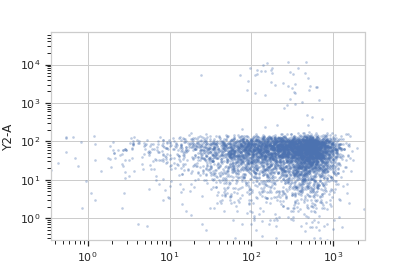
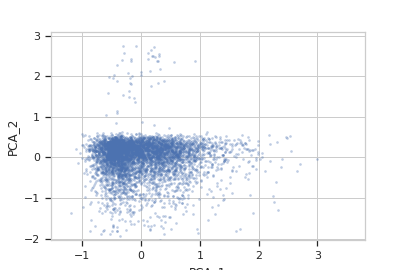
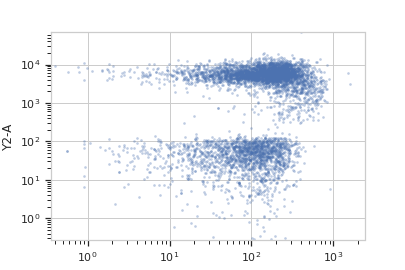
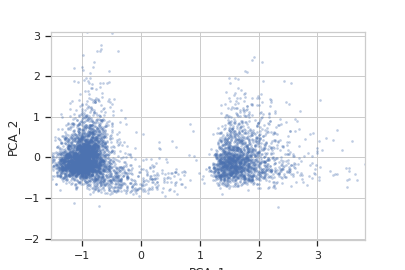
Plot a scatterplot of the PCA. Compare to a scatterplot of the underlying channels.
>>> flow.ScatterplotView(xchannel = "V2-A",
...                      xscale = "log",
...                      ychannel = "Y2-A",
...                      yscale = "log",
...                      subset = "Dox == 1.0").plot(ex2)
>>> flow.ScatterplotView(xchannel = "PCA_1",
...                      ychannel = "PCA_2",
...                      subset = "Dox == 1.0").plot(ex2)
>>> flow.ScatterplotView(xchannel = "V2-A",
...                      xscale = "log",
...                      ychannel = "Y2-A",
...                      yscale = "log",
...                      subset = "Dox == 10.0").plot(ex2)
>>> flow.ScatterplotView(xchannel = "PCA_1",
...                      ychannel = "PCA_2",
...                      subset = "Dox == 10.0").plot(ex2)
- estimate(experiment, subset=None)[source]
Estimate the decomposition
- Parameters
experiment (Experiment) – The
Experimentto use to estimate the k-means clusterssubset (str (default = None)) – A Python expression that specifies a subset of the data in
experimentto use to parameterize the operation.
- apply(experiment)[source]
Apply the PCA decomposition to the data.
- Returns
a new Experiment with additional
Experiment.channelsnamedname_1 ... name_n- Return type